HCC V28 is no longer a transition; it's the rule. As of January 1, 2026, CMS-HCC Version 28 governs 100% of Medicare Advantage risk scores, and V24 has been fully retired. The diagnoses your teams capture today determine reimbursement today, not some future payment year. Organizations that used 2024–2025 to prepare are seeing a manageable shift. Those still coding to V24 logic are feeling the full impact at once: fewer qualifying codes, tighter documentation requirements, and closer audit scrutiny. This post breaks down what changed, what full V28 means for RAF scores and MEAT-based documentation, and how leading value-based care (VBC) organizations are using Navina's AI copilot to stay ahead.
What you'll learn
- Why V28 is now the only CMS-HCC risk adjustment model, and what happened to V24
- What changed between V24 and V28, and why RAF scores dropped for most patients
- Why MEAT criteria has become the anchor for defensible V28 documentation
- What CMS's CY2027 Rate Announcement means for the year ahead
- How Navina helps VBC organizations protect RAF accuracy under the new model
What is HCC V28, and why did CMS change the model?
CMS HCC models are the formulas used to calculate risk scores for patients based on their diagnoses and demographics. In Medicare Advantage, every diagnosis code a provider documents maps to an HCC category, and each HCC contributes to a patient’s RAF score. The higher the RAF score, the more complex (and costly) the patient’s care is expected to be, which in turn influences reimbursement to health plans and provider groups.
However, healthcare evolves quickly – new conditions emerge, coding practices change, and some diagnoses turn out not to drive costs as much as previously thought. CMS introduced V28 to improve the accuracy and fairness of risk adjustment. The V28 model is built on more recent data and on ICD-10 codes rather than legacy ICD-9 mappings. By rebuilding the model with updated diagnosis and cost data, V28 aims to better reflect current disease patterns, treatment methods, and true cost drivers.
The V24-to-V28 HCC model timeline: Now complete
CMS phased in V28 over three payment years to give Medicare Advantage plans and providers time to adjust. In payment year 2024, risk scores were based on 67% V24 and 33% V28. In 2025, the mix shifted to 33% V24 and 67% V28. Beginning in 2026, V28 is fully implemented, with 100% of risk scores calculated under the V28 model. The transition is now complete, and V24 is no longer part of the payment-year calculation.
Key differences between HCC V24 and V28
So what exactly changed from V24 to V28? In a nutshell, V28 is a more refined and selective model. The number of HCC categories increased from 86 in V24 to 115 in V28, reflecting more granular groupings of conditions. At the same time, the total number of diagnosis codes that map to any HCC actually dropped significantly – down to about 7,770 codes in V28 from 9,797 in V24. 2,294 diagnosis codes deemed less predictive of costs no longer map to an HCC, while only 268 new codes were added. In other words, many diagnoses that would boost RAF in V24 no longer do in V28, and a smaller set of new diagnoses will now count toward risk scores.
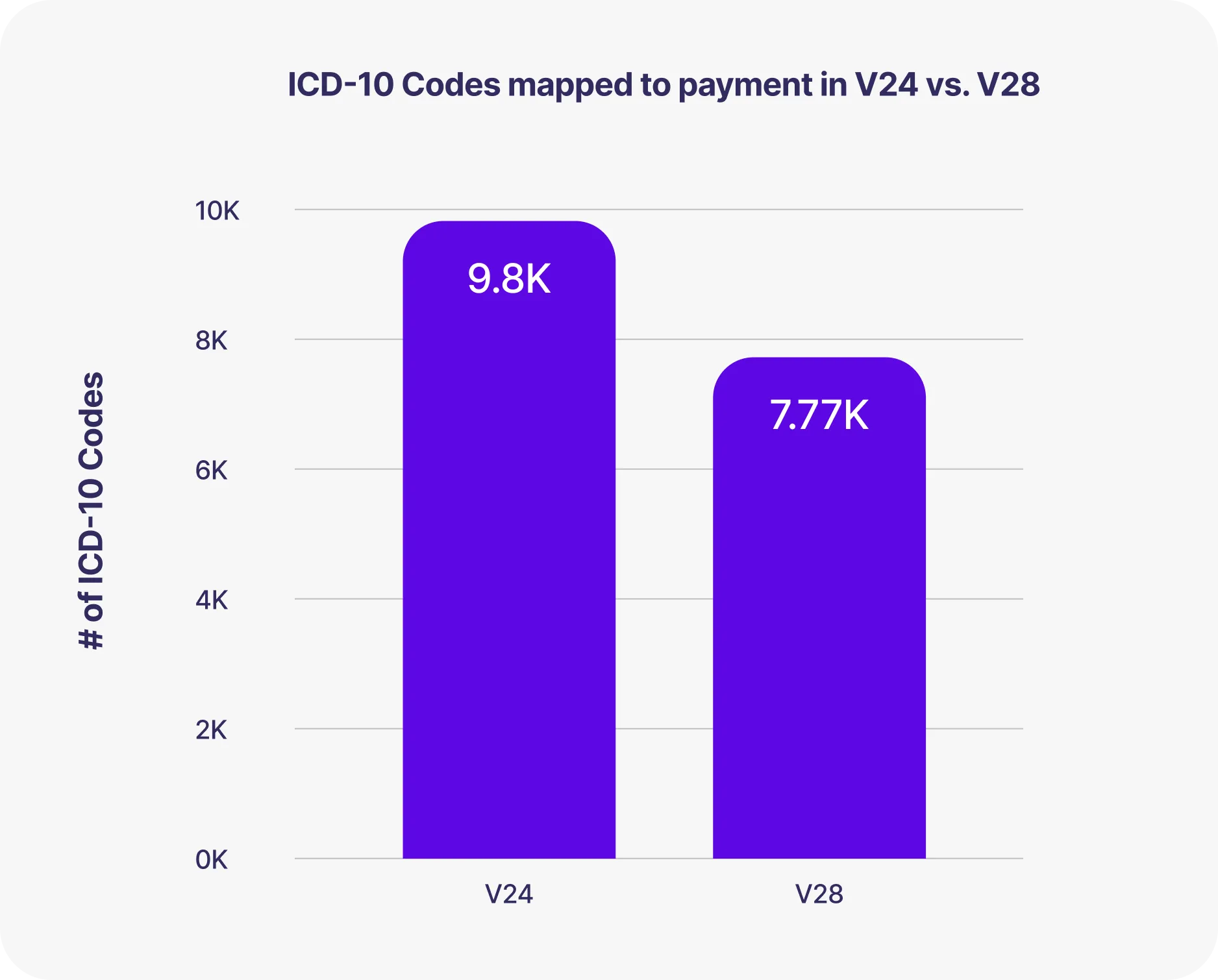
Bar chart comparing ICD-10 diagnosis codes mapped to HCC payment categories: 9,800 under V24 versus 7,770 under HCC V28.
What was removed from V28?
Generally, V28 drops some lower-severity or resolved conditions that were weighted in V24. For example, diagnoses like stable or unspecified angina pectoris (chronic chest pain) and mild or remission-stage mental health disorders (e.g. depression or bipolar disorder in full remission) no longer map to an HCC in V28. Certain substance use disorder codes (like uncomplicated alcohol or cannabis abuse) were removed as well. Some acute conditions that might not indicate prolonged costs, such as acute kidney injury (acute kidney failure), were also taken out of the model. Some relatively minor procedures or complications, like toe amputations or vascular disease without complication, were dropped. The thinking behind this is that these conditions either resolve or don’t carry the same weight for future costs, and including them was inflating risk scores under V24 without corresponding cost increases.
What was added or changed under V28?
V28 introduced new HCC categories to capture serious chronic conditions and complexities that weren’t separately recognized before. Notable new HCCs include Severe Persistent Asthma (HCC 279) and Pancreas Transplant Status (HCC 35). The 268 ‘new’ diagnosis codes include severe asthma with complications, alcoholic hepatitis, eating disorders like anorexia/bulimia, and rare diseases like Wilson’s disease are now risk-adjustable. In addition, several existing HCCs were split into more granular categories. A good example is Congestive Heart Failure (CHF) – under V24, CHF was a single category, but in V28 it’s split into five categories based on severity and ejection fraction, to more precisely reflect how severe heart failure is. Similarly, Chronic Kidney Disease Stage 3 was split into 3a and 3b, and Dementia was divided into mild, moderate, severe (HCCs 125–127). These changes encourage providers to document the severity level, not just the presence of a condition.
Overall, the trend with V28 is toward more specific coding and a tighter scope of what counts toward RAF, demanding higher documentation specificity to ensure that the patient's illness burden is accurately captured. Conditions that truly drive costs (progressive chronic diseases, severe or ongoing conditions) are emphasized, while diagnoses that are incidental or well-controlled (and thus less costly) contribute less or not at all.
The impact of HCC V28: Lower RAF scores, higher documentation bar
CMS estimates that the V28 model and related changes will reduce Medicare Advantage risk scores by approximately 3% on average. UnitedHealth Group also cited the V28 model as one factor affecting its early 2025 Medicare Advantage results. Now that V28 is fully in effect, organizations are seeing the full impact of the model rather than a gradual transition. With fewer diagnoses mapping to HCCs and greater emphasis on specific documentation, coding and clinical teams need to capture relevant diagnoses accurately and support them with appropriate documentation.
MEAT criteria: The new anchor for defensible HCC V28 coding
MEAT stands for Monitor, Evaluate, Assess, and Treat. These criteria help show that a diagnosis was actively addressed during a patient encounter rather than simply listed in the medical record. Under HCC V28, this is especially important because the model uses more specific HCC categories and recognizes fewer diagnosis codes overall. Clear, specific documentation helps ensure that relevant conditions are accurately captured and supported.
Strong documentation also helps organizations prepare for audits. A 2026 HHS Office of Inspector General report found that some submitted acute stroke diagnosis codes were not supported by the corresponding medical records, highlighting the importance of documentation that clearly supports reported diagnoses.
Navina's AI engine surfaces suspected and documented HCCs at the point of care, so coders and clinicians can confirm MEAT-compliant documentation in real time. This gives clinicians and coding teams the information they need to review and confirm diagnoses, while keeping the final decision with the clinical and coding teams.
{{text-banner}}
How Navina helps mitigate the RAF drop under HCC V28
The good news is that while the V28 model sets a new bar, organizations equipped with Navina’s advanced AI solution are mitigating the impact. Navina uses AI to analyze patient data and surface chronic conditions or gaps in documentation, helping providers ensure no important diagnosis is overlooked during a visit. This technology is crucial under V28 because it identifies those high-value conditions, including the new V28-added codes, that providers might miss.
Data from Navina’s network of partner organizations shows several encouraging trends:
- There was a 106% year-over-year increase in the capture of “V28-only” codes among the same cohort of patients. In other words, providers using Navina are documenting twice as many of these newly important conditions as they did before – a positive sign that we’re adapting to the new model. This increase indicates Navina’s success in flagging these conditions during patient encounters.
- Providers who used Navina more frequently achieved a 45% higher RAF increase for their patients compared to providers who used the platform less. This indicates that consistent use of AI assistance leads to more comprehensive coding of chronic conditions, directly cushioning the blow of the V28 model changes.
One Navina partner organization saw that over a two-year period, the average RAF per patient still rose by 0.34 when using the V28 model – whereas under V24 those same patients’ RAF would have risen by 0.56 in two years. While the RAF growth was smaller with V28, thorough coding supported by AI allowed them to achieve a positive gain. Without such efforts, many groups might have seen flat or negative RAF trends.
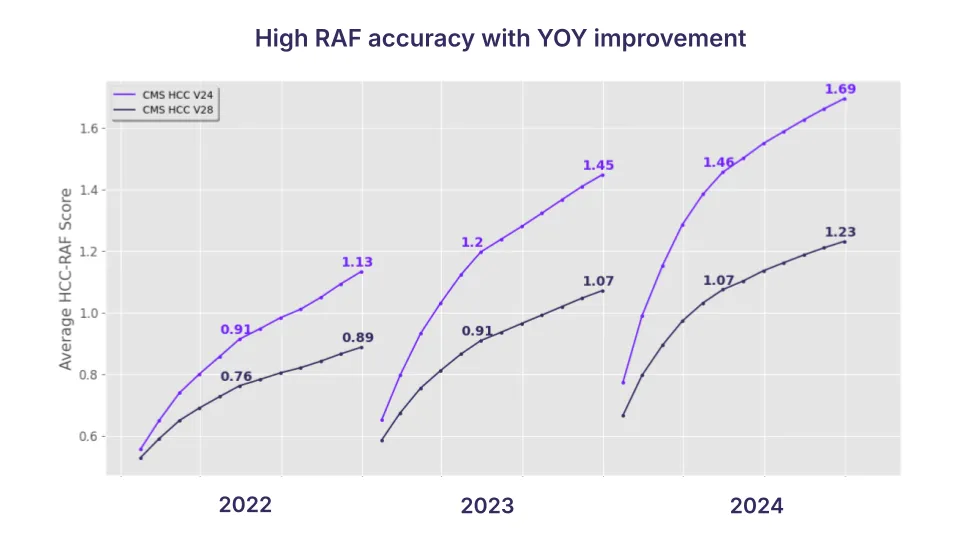
Forward-thinking organizations in 2025 are learning to work smarter within the new model. Provider education has been key, as clinicians and their staff learn the nuances of the new codes. For example, accurately recognizing (and documenting) a condition like severe asthma or chronic kidney disease stage 3b in a patient can now make a tangible difference in their risk score. Navina’s AI serves as a powerful copilot, identifying these potential diagnoses deep within patient records and bringing them to the provider’s attention.
The result: even though V28 shrinks the pool of countable diagnoses, providers can still succeed by capturing the full complexity of the patient’s health status that V28 is designed to reward.
"Navina was named Best in KLAS 2025 in the Clinician Digital Workflow category, its second consecutive year of recognition."
Thriving under V28: A new normal for risk adjustment
The gap between organizations with strong coding practices and those without them is widening. Groups that code V28 conditions accurately and document them with specificity are holding on to more of their risk score, while others risk falling behind.
Closing that gap comes down to a few habits. Document every condition at the level of specificity V28 expects, and make sure each diagnosis is supported by clear clinical evidence. Review charts thoroughly so that nothing important slips through the cracks. AI-assisted coding and clinical review can help here. Navina surfaces the evidence behind relevant conditions at the point of care, so teams can code accurately and keep closing care gaps.
Accurate coding also supports better care, since capturing a condition is often the first step to addressing it. Organizations that stay informed, use the right technology, and focus on the conditions that matter most for each patient will be best positioned to thrive in value-based care.
What's next for HCC V28: CY2027 and beyond
CMS did not introduce a new risk adjustment model for CY2027, so V28 remains the model organizations should plan around for the year ahead. As organizations continue adapting to V28, accurate coding, specific documentation, and strong clinical support will remain important for capturing patient risk appropriately.
Key Takeaways
- V28 is the only model now. As of 2026, CMS-HCC V28 determines 100% of Medicare Advantage risk scores, and V24 is fully retired.
- Expect lower RAF scores. CMS estimates V28 and related changes reduce Medicare Advantage risk scores by about 3% on average, because fewer diagnosis codes map to an HCC.
- Specificity matters more than ever. V28 splits conditions like heart failure, CKD stage 3, and dementia into severity-based categories, so document severity and not just the diagnosis.
- Use MEAT to support every diagnosis. Documenting how each condition was monitored, evaluated, assessed, or treated makes coding defensible and audit-ready.
- Capture the V28-added conditions. Newly weighted diagnoses, such as severe persistent asthma, are easy to miss without a systematic review.
- Use AI to close the gap. Navina surfaces suspected and documented HCCs, with the supporting clinical evidence, at the point of care. Final decisions stay with clinicians and coders.
See your RAF accuracy under HCC V28: Book a Strategy Call
Reviewed by Coding/Clinical SME